Regionalism and Modern Europe by Xosé M. Núñez Seixas Eric Storm
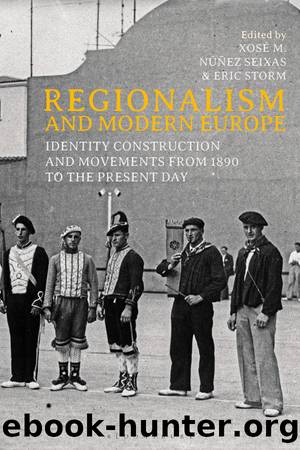
Author:Xosé M. Núñez Seixas, Eric Storm [Xosé M. Núñez Seixas, Eric Storm]
Language: eng
Format: epub
Tags: Nonfiction, History, European General, Social & Cultural Studies, Political Science
ISBN: 9781474275224
Publisher: Bloomsbury Publishing
Published: 2018-12-13T05:00:00+00:00
Contested revaluations
Leaving the world of rubble behind them, West Germans, Austrians and other West Europeans experienced tremendous economic growth, followed by a series of political, cultural and generational changes that would alter attitudes towards regionalism. In the short term, economic growth harmonized with regionalist desires, facilitating reconstruction and domestic nesting, while providing additional resources for regional cultural activities. Throughout this period, Heimat films also reached their height in West Germany and Austria, depicting the âwholesomeâ rural life, often situated in mountainous bucolic landscapes. While historians have debated whether such films were anti-modern and escapist or about negotiation between modernity and rootedness, they often represented a generic regionalism that was less representative of popular interest in Heimat.94 Popular desires for Heimat after the war were for places anything but generic, and, as one Lower Saxon Heimat enthusiast argued, film often misrepresented experience of Heimat.95
Over the long term, economic growth and reconstruction reduced both the fears of lost Heimat and compensatory needs for local communities which had fuelled regionalism. By the end of the 1950s, the Heimat concept also became increasingly intertwined in heated political debates over expellee claims to the former east. While emphasis on an expellee âright to Heimatâ seemed more reasonable in the early post-war years, passage of time, increased integration, the unlikelihood of return and desires for rapproachment with the east brought the Heimat concept increasingly into heated Cold War debates. These developments combined in the 1960s with generational changes that resulted in a cultural turn against regionalism.
A new youth generation differed from their parents in coming of age at a time of stability, more intact communities and absence of forced movement, with their perception of Heimat increasingly coloured by its use in rancorous expellee politics. They also reacted against their parentsâ generation preoccupation with local rootedness. As one author argued, she had been âfattened upâ with âHeimatâ and Swabian regionalism in her youth, leading her to grow tired of home and craving foreign places.96 Many responded to expelleeâs political wielding of Heimat against rapprochement by appropriating histories of its misuse in Nazi propaganda. As the author Gabriele Wohmann wrote in the mid-1960s, reflecting on expellee rhetoric, âHeimat Heimat Heimatâ provoked sentimental recalcitrant impulses that do not allow peace without âHeimatâ. Displaying little knowledge of the conceptâs history, Wohmann claimed it had been on its death bed in the Weimar years until its great awakening under Nazism when, so she claimed, the range of compound words with Heimat had been formed.97 The 1960s further saw the elimination of Heimatkunde as a school subject in most states, while anti-Heimat films and anti-Heimat literature emerged as artistic genres which depicted regional culture as largely backward, ruralist and regressive.
Regionalists societies by no means closed down in the 1960s, while the 1970s and 1980s saw contested regionalist revivals, with progressives playing a notable role. After a period of economic stagnation and disappointment over failed utopian visions of the 1960s, regionalism came to the fore as a means of protesting environmental destruction, centralization and technocratic remaking of cities and local landscapes.
Download
This site does not store any files on its server. We only index and link to content provided by other sites. Please contact the content providers to delete copyright contents if any and email us, we'll remove relevant links or contents immediately.
The Vikings: Conquering England, France, and Ireland by Wernick Robert(84424)
Ali Pasha, Lion of Ioannina by Eugenia Russell & Eugenia Russell(40336)
The Conquerors (The Winning of America Series Book 3) by Eckert Allan W(38068)
The Vikings: Discoverers of a New World by Wernick Robert(37024)
Cecilia; Or, Memoirs of an Heiress — Volume 1 by Fanny Burney(32655)
Cecilia; Or, Memoirs of an Heiress — Volume 2 by Fanny Burney(32026)
Cecilia; Or, Memoirs of an Heiress — Volume 3 by Fanny Burney(32007)
Empire of the Sikhs by Patwant Singh(23150)
The Secret History by Donna Tartt(19357)
Hans Sturm: A Soldier's Odyssey on the Eastern Front by Gordon Williamson(18665)
Cat's cradle by Kurt Vonnegut(15469)
Pimp by Iceberg Slim(14713)
Sapiens: A Brief History of Humankind by Yuval Noah Harari(14481)
Norse Mythology by Gaiman Neil(13474)
Talking to Strangers by Malcolm Gladwell(13474)
Leonardo da Vinci by Walter Isaacson(13429)
4 3 2 1: A Novel by Paul Auster(12544)
Underground: A Human History of the Worlds Beneath Our Feet by Will Hunt(12173)
The Radium Girls by Kate Moore(12120)
